
A PRACTICAL GUIDE TO INITIAL ASSESSMENT AND CASE CONCEPTUALIZATION
The Guiding Place
Couldn't load pickup availability
A Practical Guide to Initial Assessment and Case Conceptualization
From Gathering Information to Understanding the Client
A thorough clinical assessment requires more than collecting symptoms, documenting history, and assigning a diagnosis. Therapists must determine how a client's difficulties developed, what maintains them, which strengths support recovery, and where treatment is most likely to make a meaningful difference.
A Practical Guide to Initial Assessment and Case Conceptualization teaches clinicians how to turn assessment information into a coherent, clinically useful understanding of the person they are treating.
Built around an eight-part framework, this guide provides a systematic approach to organizing clinical information, developing a working formulation, identifying treatment priorities, and translating clinical reasoning into an actionable treatment plan.
What the Guide Covers
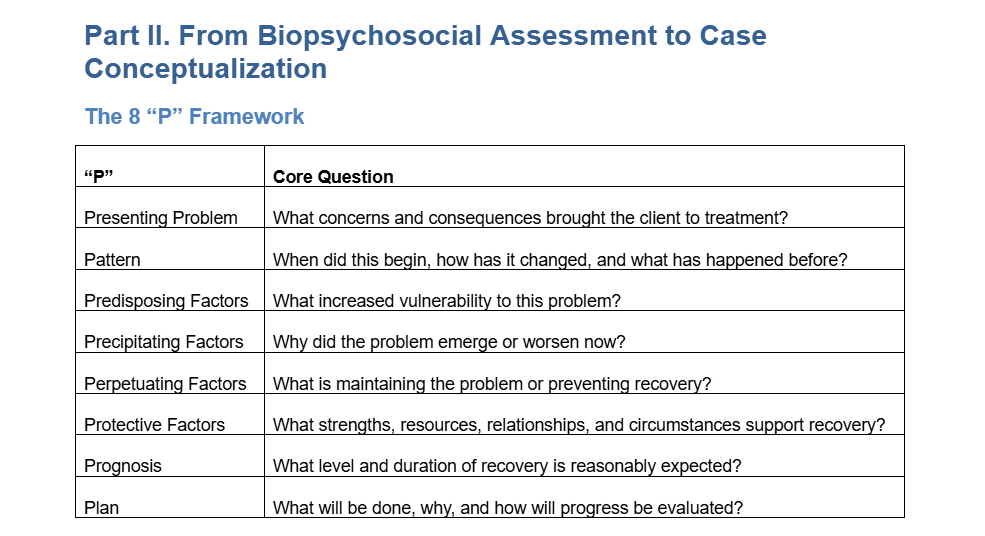
A structured eight-part framework for case conceptualization
The guide organizes clinical reasoning around eight interconnected components:
Presenting: What problems, symptoms, and functional difficulties brought the client to treatment?
Pattern: How do thoughts, emotions, bodily sensations, behaviors, and environmental circumstances interact?
Predisposing: What historical, developmental, biological, psychological, and social factors may contribute to vulnerability?
Precipitating: What events or changes contributed to the onset or worsening of the current problem?
Perpetuating: What processes continue to maintain the client's difficulties?
Protective: What strengths, relationships, resources, values, and existing skills support recovery?
Prognosis: What factors influence the likely course of treatment and the client's capacity for change?
Plan: Which clinical targets, interventions, and next steps follow from the formulation?
Practical tools and applied learning
The guide includes structured assessment prompts, formulation templates, an eight-part assessment form, quality-control questions, applied case examples, and exercises designed to strengthen clinical reasoning. These resources help clinicians move from abstract theory to practical use in actual treatment settings.
Why This Guide Is Valuable
A strong case conceptualization gives therapy direction. Without one, clinicians can become focused on symptom lists, isolated incidents, or interventions that lack a clear connection to the client's needs.
This guide helps therapists:
Organize complex information. Identify the details that matter clinically and understand how they relate to one another.
Develop more useful formulations. Move beyond describing symptoms to generating testable explanations of how difficulties developed and persist.
Identify meaningful treatment targets. Focus on the patterns and processes most relevant to the client's distress and functional impairment.
Choose interventions deliberately. Connect therapeutic techniques to the clinical formulation instead of selecting strategies without a clear rationale.
Recognize strengths and resources. Incorporate protective factors, personal values, relationships, and existing capabilities into treatment planning.
Improve clinical documentation. Develop a clear rationale that supports diagnostic decisions, treatment goals, and the medical necessity of services.
Adapt as treatment progresses. Treat the formulation as a working hypothesis that can be refined when the client's circumstances, symptoms, or response to treatment change.
Who Should Use This Guide?
This resource is designed for beginning therapists, graduate-level clinicians, clinical interns, experienced practitioners seeking a more systematic approach, and clinical supervisors teaching assessment and case formulation.
It can support individual study, supervision discussions, clinical training, and the development of consistent assessment practices across a treatment team.
Build a Clearer Path From Assessment to Treatment
The initial assessment establishes what is happening. Case conceptualization explains how the pieces may fit together. Treatment planning identifies what to address and why.
A Practical Guide to Initial Assessment and Case Conceptualization brings these tasks together in a structured, teachable process. It helps clinicians develop a clearer understanding of their clients, make more intentional treatment decisions, and establish a stronger foundation for effective psychotherapy.
The goal is straightforward: move from gathering information to understanding the client, then use that understanding to guide the work of therapy.
Not sure if this resource is the right fit? Use this quick guide to evaluate therapy resources before you buy.