
A Practical Guide to Session Notes
The Guiding Place
Couldn't load pickup availability
A good therapy session can contain excellent clinical work and still produce a weak progress note.
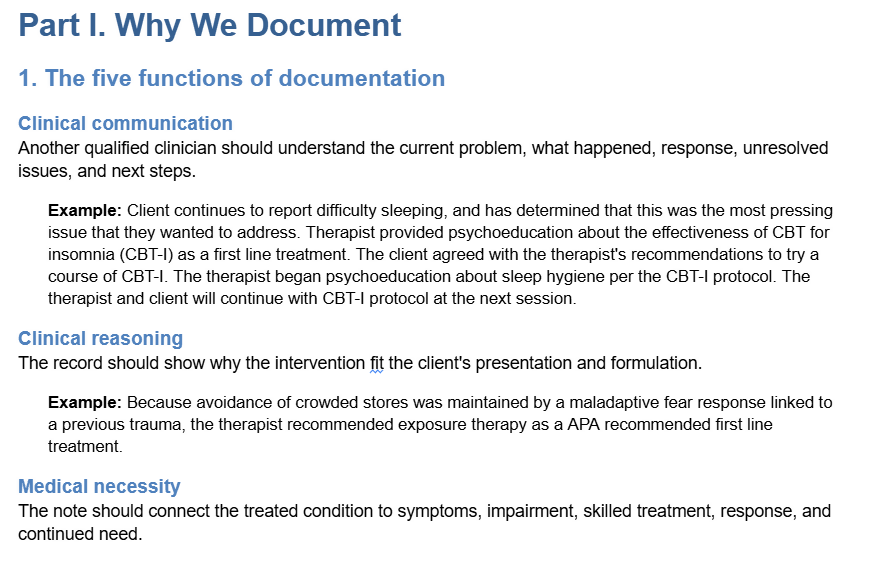
A Practical Guide to Session Notes teaches clinicians how to translate the actual work of psychotherapy into documentation that communicates clinical reasoning, demonstrates medical necessity, supports continuity of care, and creates a clear professional record.
Built as a companion to A Practical Guide to Initial Assessments and Case Conceptualization, this guide follows the clinical process beyond the initial assessment. It shows therapists how to take what they understand about a client and accurately document what happens in treatment from session to session.
What You'll Learn
The guide breaks the session note into the elements that matter most:
- What the client reports: symptoms, changes, stressors, functioning, and treatment response
- What the clinician observes: relevant behavioral observations and mental-status information
- Clinical assessment: what the information means and how the client's presentation is changing
- Intervention: what the therapist actually did, including specific CBT, ACT, MI, Person-Centered, and trauma-focused interventions
- Client response: what happened as a result of the intervention
- Progress toward treatment goals: improvement, stability, barriers, minimal progress, or regression
- Risk and safety: documenting clinically significant risk assessment and response
- Medical necessity: connecting diagnosis, symptoms, functional impairment, intervention, response, and continued need for treatment
- Diagnosis: maintaining documentation that supports the clinical picture
- Treatment planning: connecting individual sessions to treatment goals and objectives
- The 8 P case formulation: showing how Presenting, Pattern, Predisposing, Precipitating, Perpetuating, Protective, Prognosis, and Plan information translates into ongoing documentation
This guide teaches how to think about documentation, rather than simply giving therapists another SOAP-note template.
It explains why statements such as “discussed anxiety,” “processed trauma,” “worked on coping skills,” and “client is doing better” provide little clinical information. It then demonstrates how to transform those statements into documentation that identifies the clinical problem, intervention, response, progress, and rationale for continued treatment.
The guide also addresses situations that often make documentation difficult:
- Minimal-progress sessions
- Regression
- Client disagreement
- Missed appointments
- Crisis sessions
- Suicidal ideation and safety concerns
- Collateral contacts
- Coordination of care
- Telehealth
- Referrals and higher levels of care
- Treatment-plan changes
- Therapist errors and corrections
- Addenda and late entries
- Medical-record versus psychotherapy-note distinctions
Extensive Before-and-After Examples
One of the guide's greatest strengths is its emphasis on examples.
It provides examples across common clinical presentations, including:
- Depression
- PTSD and trauma
- Anxiety and panic
- Substance use
- Anger
- Relationship conflict
- Suicidal ideation
- Minimal progress
- Regression
- Telehealth
- Client disagreement
- Higher levels of care
Each example demonstrates the difference between vague documentation and clinically meaningful documentation.
Designed With Real-World Compliance in Mind
The guide also explains the relationship between clinical documentation and the requirements that affect practicing therapists.
It includes discussion of:
- State Recordkeeping requirements
- Medicaid psychotherapy documentation requirements
- Medical necessity
- Diagnosis and functional impairment
- Medicare psychotherapy documentation requirements
- HIPAA and the distinction between medical records and separately maintained psychotherapy notes
- Telehealth documentation
- Authentication and record integrity
- Corrections and addenda
- Documentation requirements that vary by payer, program, and setting
A Practical Framework for Every Session
At the center of the guide is a simple clinical documentation sequence:
Problem → Clinical Reasoning → Intervention → Response → Progress → Continued Need → Plan
This framework gives therapists a reliable way to organize a note without turning every session into a lengthy narrative.
The result is documentation that is:
- Clinically meaningful.
- Concise.
- Specific.
- Connected to treatment goals.
- Supportive of medical necessity.
- Useful for continuity of care.
- Defensible when the record is reviewed.
Includes Practical Tools
The guide concludes with tools clinicians can use immediately, including:
- A universal session-note framework
- Treatment-plan linkage examples
- 8 P formulation-to-note mapping
- SOAP, DAP, BIRP, and GIRP comparisons
- Documentation exercises with model answers
- Before-and-after documentation examples
- A 60-second session-note audit
- A five-purpose documentation audit
- A longitudinal-record test
- A common documentation failures checklist
- A quick-reference documentation card
A Practical Guide to Session Notes is designed for therapists who want their documentation to reflect the quality of their clinical work.
The goal is simple: when someone reads the record, they should be able to understand what was happening clinically, why the therapist did what they did, how the client responded, what changed, and why the next step makes sense.
Not sure if this resource is the right fit? Use this quick guide to evaluate therapy resources before you buy.